46/46
Reference cases
Test conversations replayed before every change. All of them passed.
46 of 46 answered right
one dot per case · measured Jul 12, 2026
CASE STUDY — STRATNOVA
SaaS · AI on WhatsApp · Product, UX and Design Engineering · Pre-launch
My role: Founder & Design Engineer — from strategy and conversation design to the interface and the code.
Service businesses lose customers on WhatsApp: the message arrives while they are with a client, and by the time they reply, the person has booked somewhere else. StratNova puts Nova to answer, book and charge in the same chat. The design challenge was not the screen: it was deciding who does the thinking, the model or the code.
46/46
Reference cases
Test conversations replayed before every change. All of them passed.
46 of 46 answered right
one dot per case · measured Jul 12, 2026
10/10
Zero made-up facts
Conversations where Nova only quoted the business's real prices and hours.
10 of 10 without a made-up price or time
one mark per conversation · Jul 12, 2026
1.5s
Response time
Median: the customer gets the answer before putting the phone down.
THE BRIEF AND THE DIAGNOSIS
Design a product for owners of service businesses —health, beauty, cleaning— that answers on WhatsApp, books and charges on its own, in Spanish or English, without the owner having to open a dashboard.
A journey map of the owner and the customer, a benchmark of the chatbots and assistants on the market, and tests with real conversations in three test businesses, before launch.
Four root wounds — the cards below, which are also the index of this story.
THE DIAGNOSIS — four root wounds (and the index of this story)
WHERE IT STARTED
Customers don't wait: if nobody answers within minutes, they book somewhere else.
And the chatbots on the market do answer, but with menus and canned phrases: they sound like a machine and never close the booking. That was the starting point.
FINDING 01
The message arrives while the owner is working; by the time they reply, it's too late.
→ Chapter: book on the spot
FINDING 02
“I'll confirm later” leaves the booking half done, and the customer leaves.
→ Chapter: close in the reply
FINDING 03
One wrong price or time breaks trust in one go.
→ Chapter: zero made-up facts
FINDING 04
Menus and canned phrases: people feel they are talking to a machine and drop off.
→ Chapter: a human voice
Four root wounds. Before healing them, I had to measure how much they hurt —
THE PROBLEM, WITH EVIDENCE
Across 52 real turns, the output filter blocked 15 answers, and 11 of them were correct. One in five people got something worse than what Nova had already written.
An “anti-invention” guard took the first of 144 services that matched and rewrote CLP 24,000 as CLP 240,000. It happened in 3 of 3 measured conversations.
Every canned reply —“the front desk will confirm”— is a lost booking, in a business where Nova is the front desk.
11 of 15
filter blocks were false positives
1 in 5
real answers came out worse than Nova's draft
3 of 3
measured conversations with the price rewritten wrong
WHAT THE REAL CASES SHOWED
“Do you treat lower back pain? When can I come?”
Nova had the right answer; the filter swapped it for “the front desk will confirm”. The business has no front desk.
Real case · test conversation
“Physio session, CLP 24,000”
Nova's answer was right; the guard rewrote it as “10 sessions, CLP 240,000”.
Real case · price guard
“See you Tuesday the 23rd”
It was a Wednesday, and times came out in UTC: the code was writing the date instead of letting the model say it.
Real case · dates and time zones
Summary of real cases measured in the project — test conversations, before launch.
With the evidence in hand, the rebuild began —
THE REBUILD
Each of these questions used to end in a lost customer.
FIRST, THE MAP
The structural answer came before any screen. Instead of writing rules to guess what the customer meant, I split the work: the model understands and decides; the code hands it every fact about the business, validates what the model chose and carries it out. If the code can't carry it out, the answer still goes out: only the action doesn't happen.


The answers that follow are built on this split — the model decides, the code acts.
01 — THE QUESTION
Before, the question went unanswered or ended in “I'll confirm”. Now Nova checks the real calendar, offers times and books the slot in the same reply.
THE BOOKING


The appointment lands in the calendar in the same reply: no “I'll confirm”, no half-done steps.
WHAT I RULED OUT — five paths that didn't heal anything
THE DECISION — One single bet: the model interprets and decides; the code only validates and acts.
THE BET — every fact on the table
THE RESULT — measured in test conversations
Reference cases
46/46
The bar is full because no case failed.
Zero made-up facts
10/10
Not one made-up price or time.
The customer has a slot. But still wanted to know the price —
02 — THE QUESTION
Before, a guard took the first similar service and rewrote the price. Now the code hands Nova the full list and she picks: when there are several candidates, the code doesn't choose for her.
THE PRICES


Nova only says what the business entered: service, duration and price.
03 — THE QUESTION
Before, Nova started without knowing who works at the business. Now every professional, their services and their next real slot live in the calendar, and Nova offers from that list.
PROFESSIONALS


Each professional with their services, their hours and what Nova knows about them today.
04 — THE QUESTION
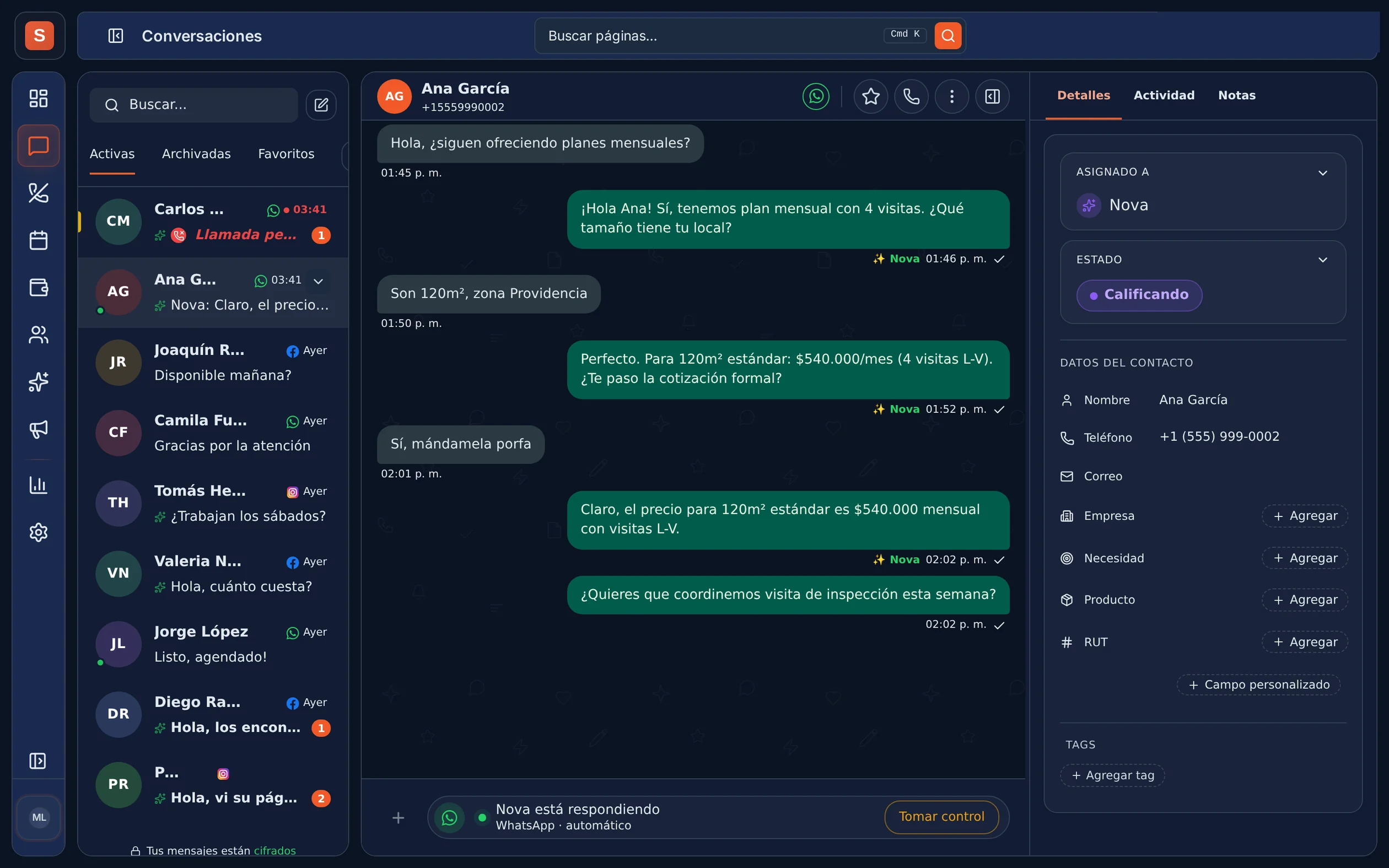
Before, asking for a human was a dead end. Now the owner sees every conversation in the panel and takes control with one button; Nova steps aside without the customer noticing.
THE PANEL


The owner sees what Nova is saying and steps in whenever they want, from the same panel.
Four questions that used to end in lost customers. Nova answers them now.
THE PROOF AND THE WRAP-UP
THE METHOD — from the real case to the product, one step at a time
Step 1
journey map and real cases
where does the customer get lost? — four wounds
Step 2
the model interprets, the code acts
who decides and who follows
Step 3
conversation, panel and code
from sketch to product, with cross-review
THE VERDICT
46/46
Reference cases
test conversations that pass on every change
10/10
Zero made-up facts
only the business's real prices and hours
1.5 s
Response time
median, from message to reply
ASIDE — WHAT GOT BUILT ALONG THE WAY
AI directors with their own roles —product, design, QA, security— coordinated like a company. I decide the product; they build and review each other.
Every change is approved by a panel of three different models before it ships. If in doubt, it doesn't ship.
The business sets itself up by chatting with Nova: services, hours and who's working, without endless forms.
IN MY WORDS
“Designing with AI isn't drawing a chat window: it's deciding who thinks. The model understands; the code carries out what the model decided.”
“And I learned that every hand-written rule meant to ‘help’ the model is a worse answer waiting for its turn.”